- Daily Energy Market Update
- Posts
- Daily Energy Market Update March 19,2026

March 19, 2026
May WTI is up $1.16 at $96.62 May RB is up 6.54 cents at $3.1369 May ULSD is up 15.79 cents at $4.1467
Liquidity’s Daily Market Overview
Energy prices are higher today as Iranian attacks have continued in the region, causing damage and disrupting oil flows. Brent oil prices' gains are outpacing those for WTI. Prices have fallen back from the overnight highs, but news wire commentary cites analysts warning of possible further upside for energy prices.
An Iranian missile inflicted “extensive damage” on the Ras Laffan complex in Qatar housing the world’s largest liquefied natural gas plant. The facility normally supplies 20% of the global LNG supply. Production there had been halted earlier in the month after prior attacks. “In a worst case scenario, Ras Laffan may not restart in 2026.”, one energy analyst said. Operations have been suspended at the United Arab Emirates’ Habshan gas facility as authorities respond to two incidents of fallen debris after the successful interception of a missile, Abu Dhabi’s media office says early Thursday. (Bloomberg/Globe and Mail/Times of Israel)
Oil loadings on Saudi Arabia’s west coast at the port of Yanbu, a vital export route for the country amid the closure of the Strait of Hormuz, were briefly halted by an attack. Loadings from Yanbu have allowed Saudi Arabia to ramp oil exports to more than half of normal levels. Shipments from Yanbu averaged about 4.19 MMBPD over the past five days, Bloomberg ship tracking shows, compared to about 1.4 MMBPD prior to the Strait of Hormuz disruption. (Bloomberg)
In Kuwait, two oil refineries were struck by drones. A limited fire at an operational unit of the 346 MBPD Mina Al-Ahmadi oil refinery has now been extinguished, as has a blaze at the 454 MBPD Mina Abdullah refinery, according to state-owned Kuwait Petroleum Corp. and its refining arm Kuwait National Petroleum Co. (Bloomberg)
President Trump responded by pressing for a de-escalation. He said Israel would refrain from further strikes on Iran’s South Pars gas field — the attack that prompted Tehran’s retaliation against Qatar. However, the president also said that the US would “massively blow up the entirety” of South Pars if Iran targets Qatar’s LNG facilities again. (Bloomberg)
Iran is weighing tolls on ships in the Strait of Hormuz as officials push for greater control of the waterway following attacks on energy sites in the Persian Gulf. (iranintl.com)
The DOE data issued Wednesday showed a build in crude supplies of 6.156 MMBBL, which we see as mostly due to the EIA's accounting adjustment. The EIA added 1.098 MMBPD to crude supply. That equates to adding 7.686 MMBBL. News wire accounts tout the fact that the crude inventories have risen to their highest level since June 21,2024. We, in fact, believe that a draw would have been more appropriate given the net import decrease of 692 MBPD coupled with the drop in US crude production of 10 MBPD and the increase in refinery inputs of 63 MBPD. Product demand was mixed --gasoline demand fell while distillate demand rose. Gasoline demand fell on the week by 513 MBPD to 8.728 MMBPD---lagging the prior 2 years demand by 89 and 81 MBPD. Distillate demand rose by 334 MBPD to a strong figure of 4.399 MMBPD---beating the prior 2 years demand by 389 and 613 MBPD.
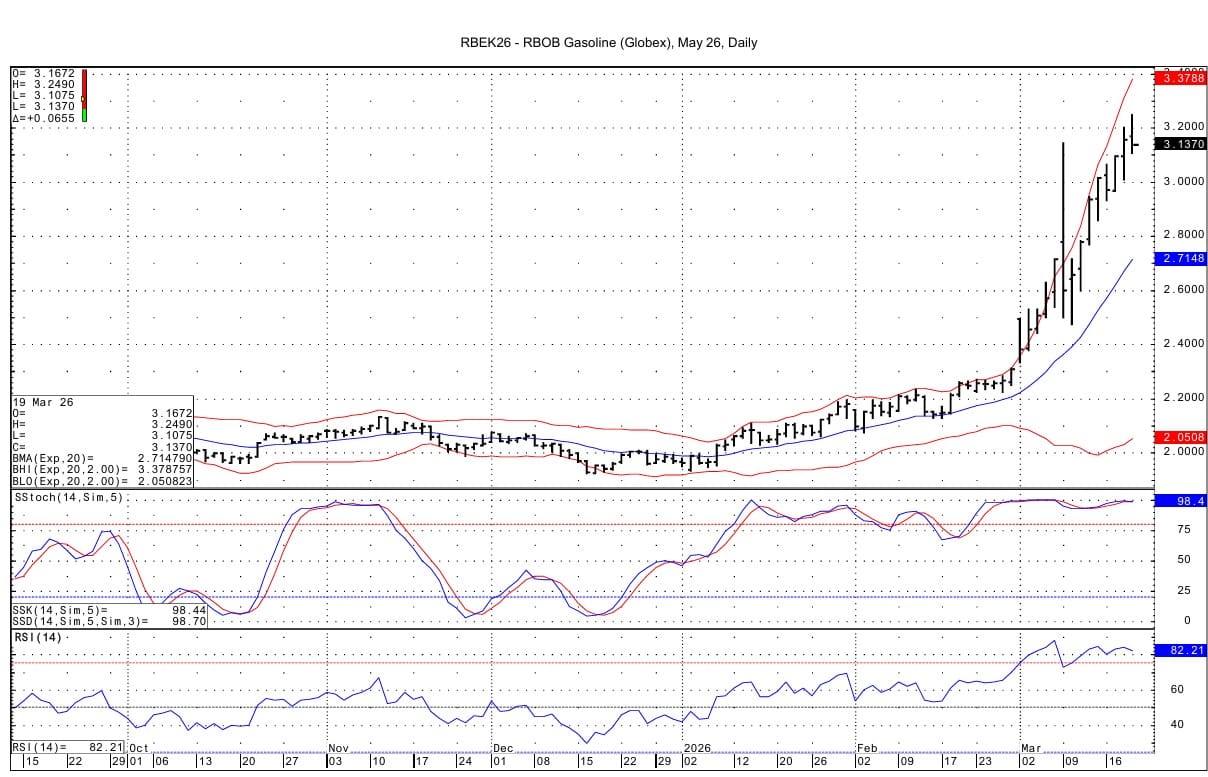
The Trump administration is expected to announce soon that it will temporarily lift federal smog-cutting restrictions on summer-blend gasoline. The move would make standard gasoline cheaper by not forcing refiners and retailers to switch to more costly summer blends of gasoline, while also allowing fuel retailers to continue selling gasoline blended with 15% ethanol, known as E15, throughout the summer driving season when stricter rules normally limit its use in much of the country. The United States normally switches to summer gasoline blends to reduce air pollution by lowering fuel evaporation in warm weather. (Reuters) This news is why RB prices fell back quite a bit from the highs of the day Wednesday, with the April and May RB contracts losing a lot of ground to the rest of the forward curve.
The WTI Brent arb for the May contract has widened by $3.14 currently today printing at a value of -$15.06. The arb was as wide as -$20.69 today. This is the widest the arb has been since March 2013. The spread was wide (favor of the Brent) pre-2015, when the US crude oil export ban was still in place. The following comments re the sharp rise for Brent versus WTI have been seen: "Supplies of light-sweet crude in the West haven’t been hit as hard, at least for now. For heavier barrels, the US can source them from Venezuela and elsewhere in Latin America. Imports of the South American nation’s crude have doubled to about 423 MBPD, the highest level since November 2024. Releases from emergency oil reserves in the US are also almost entirely made up of sour crude supplies — similar in quality to typical Middle Eastern barrels — bolstering availability for Gulf Coast processors and further cushioning the impact on US benchmark futures. "The Trump administration may decide to consider a crude-oil export levy, or possibly a ban, to combat surging energy prices caused by the war in the Middle East", according to RBC Capital Markets LLC. “Dubai trading around $150 reflects the physical reality of tightness in the region, while WTI is trading more in line with expectations around possible government intervention, whether that’s an SPR release, an export restriction, or tax changes designed to keep more barrels at home,” one energy trader says. (Bloomberg)
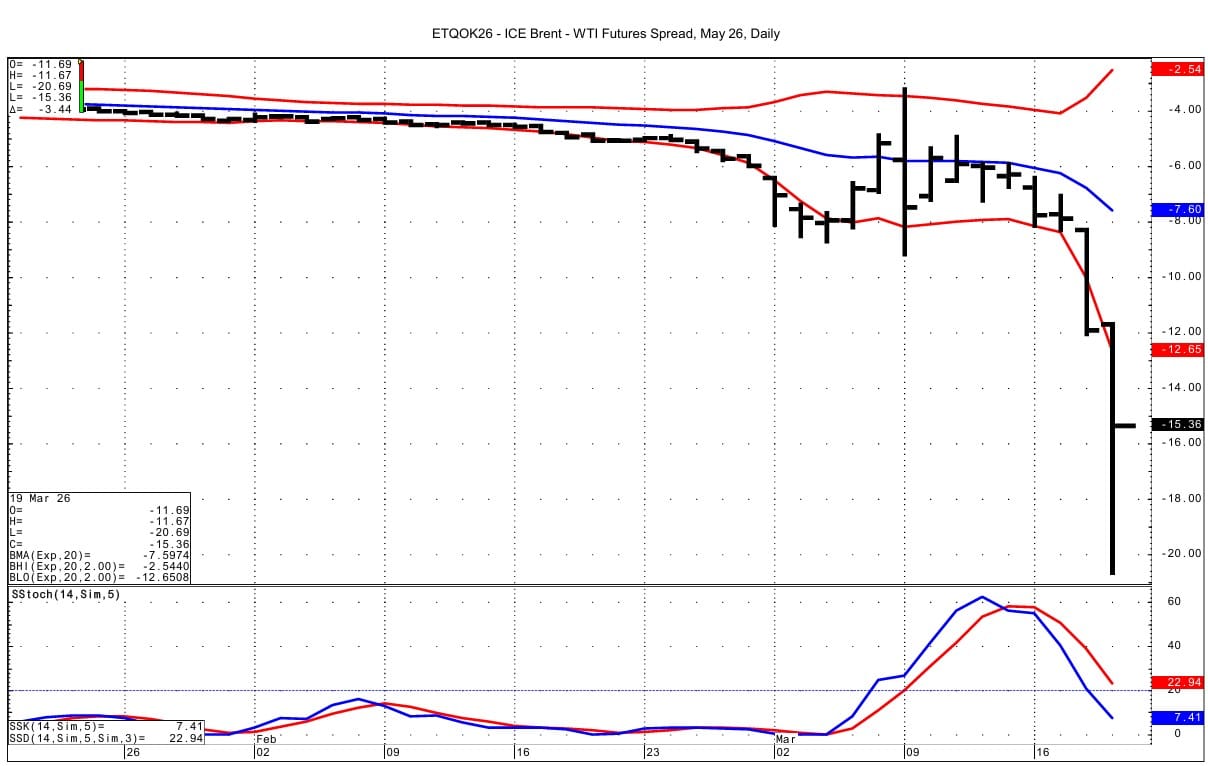
Westpac Bank analysis reads :" With no end in sight to hostilities, shut-ins rising on a daily basis, and the Strait technically closed, we remain of the view that Brent is set to remain in a new, higher $95-to-$110 range; Were we to see a major refinery plant hit or confirmation of additional mining of the strait, we would expect that range to extend higher by another $10-$20.” Threatened strikes on key energy facilities in Saudi Arabia, the UAE, and Qatar could push oil prices past $120 a barrel immediately, according to Rystad Energy. “The latest wave of attacks on energy infrastructure in the Gulf just underpins the dire supply outlook from the region for months to come,”, one bank analyst said. “If this escalates into direct hits then $120 won’t be the ceiling, it’ll be the starting point.”, one investment officer said. (Bloomberg/WSJ)
The US average fuel prices at the pump continue to rise. Gasoline is averaging $3.884, as per AAA data. That is up 4.2 cents from yesterday and +90.2 cents from February 27. The diesel price at the pump is up 3.1 cents from yesterday at $5.099. That is up $1.445 from February 27th's price.
Energy Market Technicals
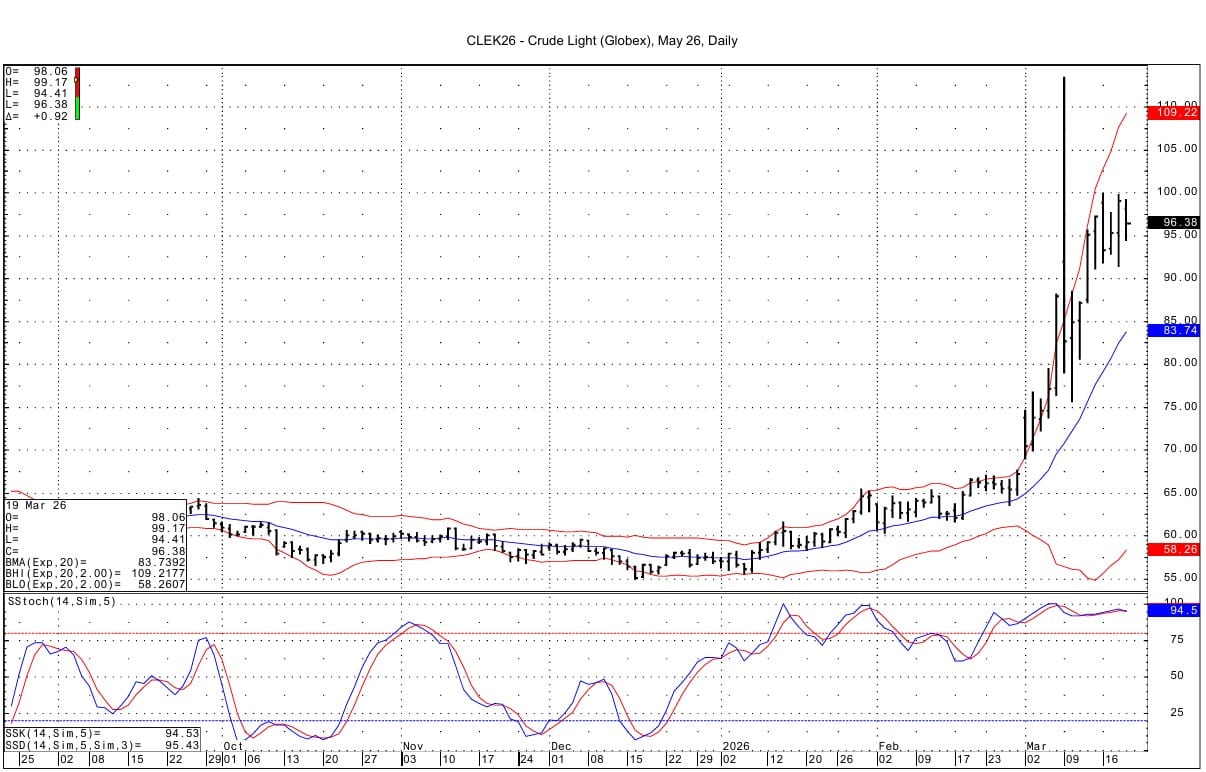
The product spot futures contract prices have risen to fresh multi-year highs today. ULSD prices are up the most again today, with the ULSD forward curve widening further in favor of the front end. The RB forward curve has not changed much as yesterday's announcement concerning US government standards for sales of summer gasoline has dampened some of the upward pressure on the front of the curve. The stochastic momentum indicator for the energies is neutral with RB and WTI' indicator looking as if it is turning downward.
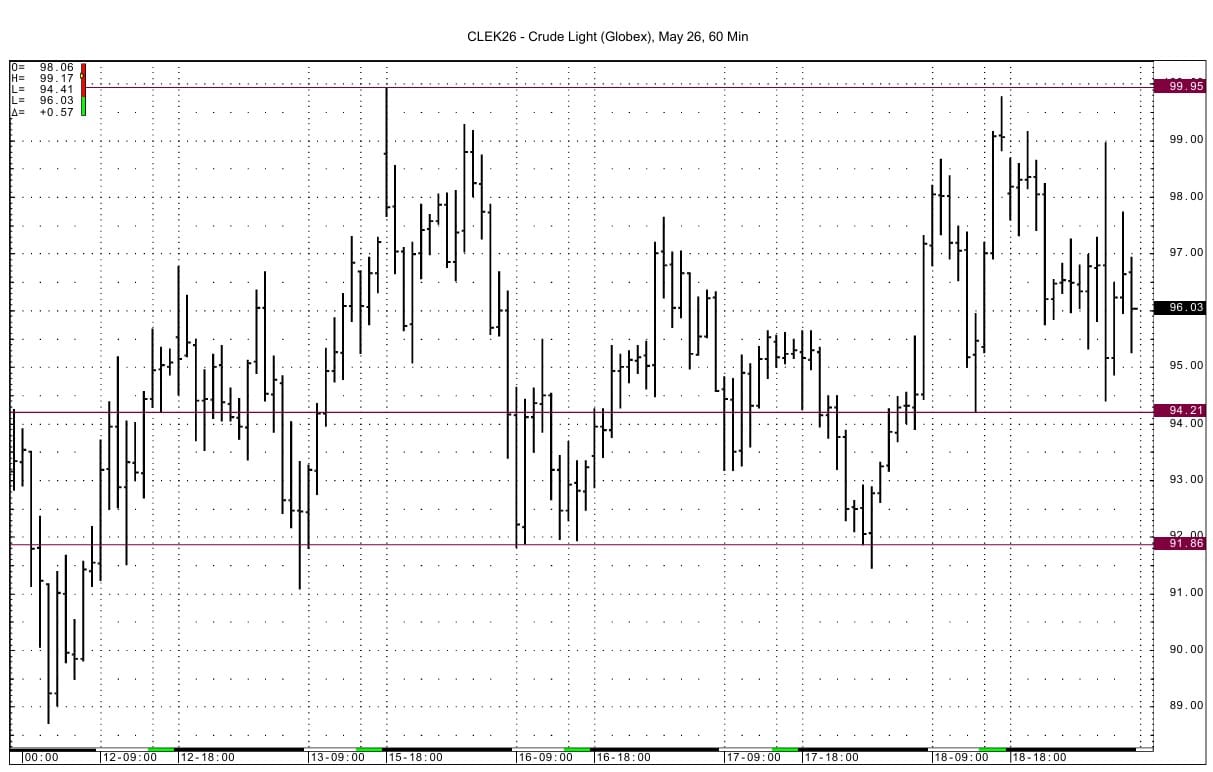
May WTI has resistance at the highs of Monday and yesterday at 99.78-99.95. Support lies at 94.21-94.29 and then at 91.82-91.88.
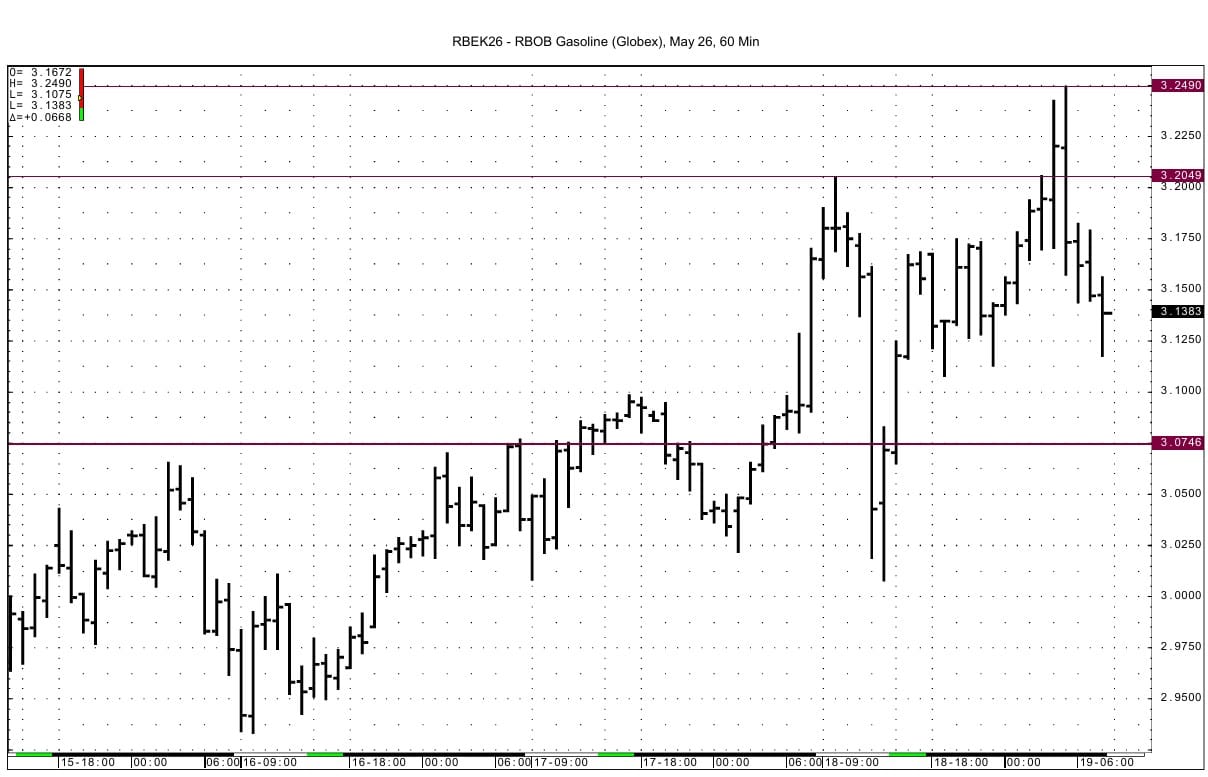
May RB support is seen at 3.0740-3.0760. Resistance lies at 3.2049-3.2060 and then at today's high of 3.2490.
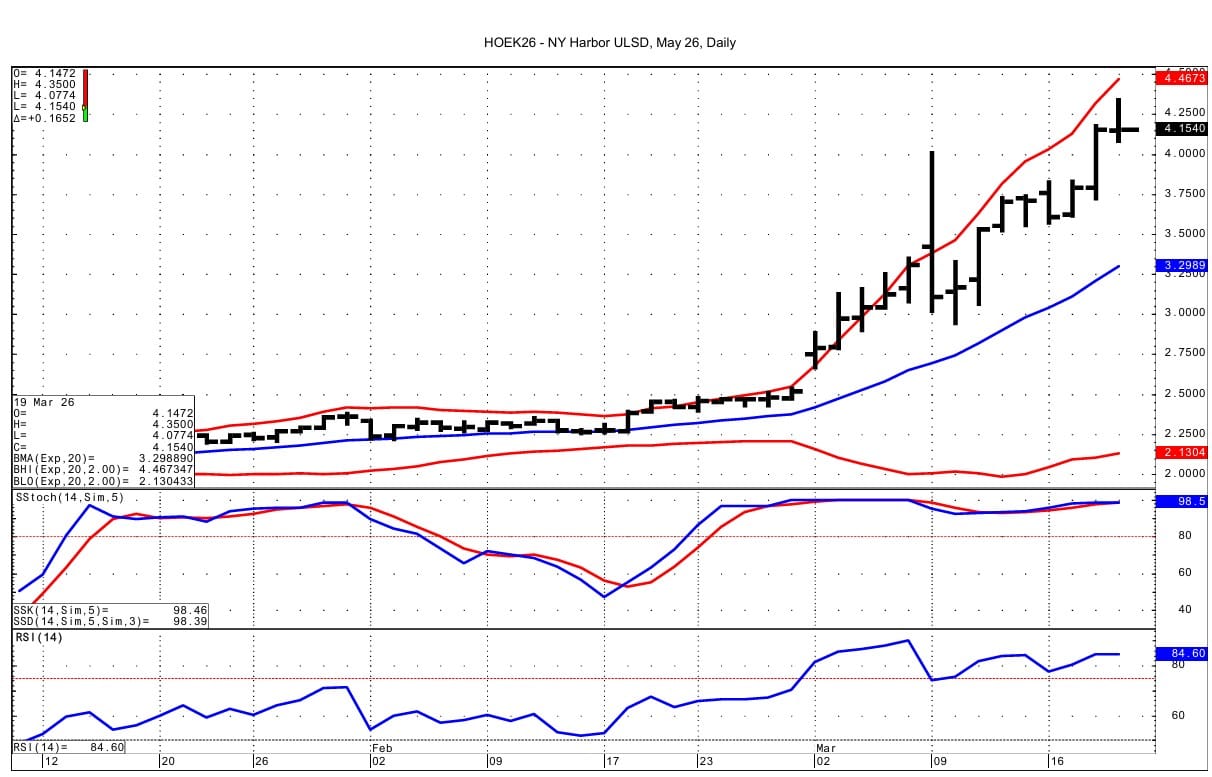
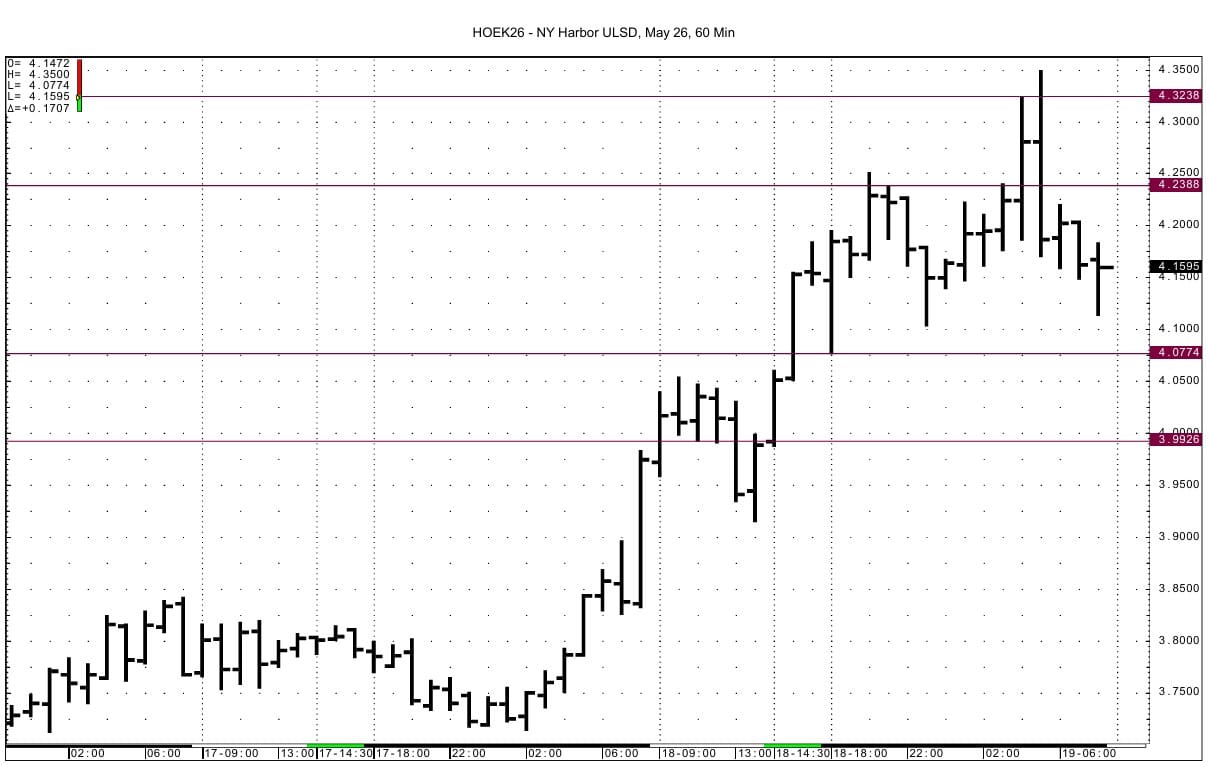
May ULSD sees support at today's low of 4.0774 and then at 3.9911-3.9926. Resistance lies at 4.2388-4.2402 and then at 4.3238. The overnight high is 4.3500.
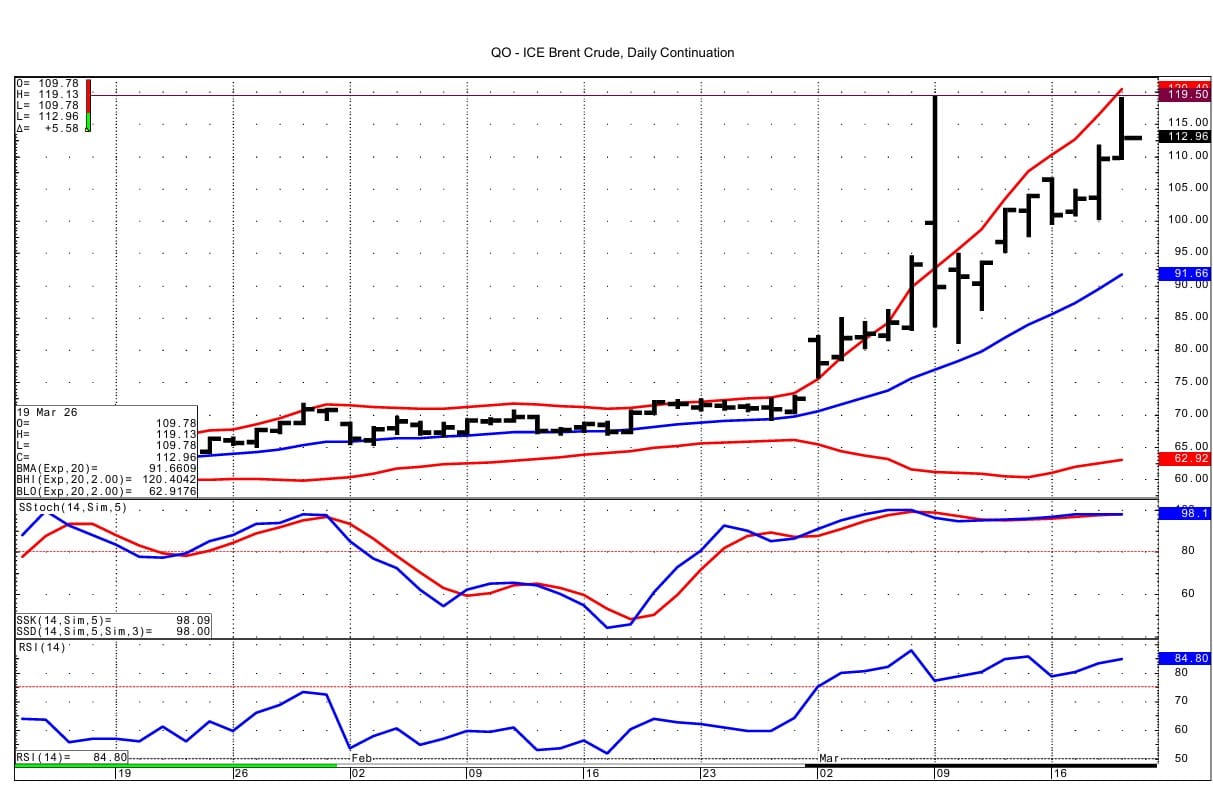
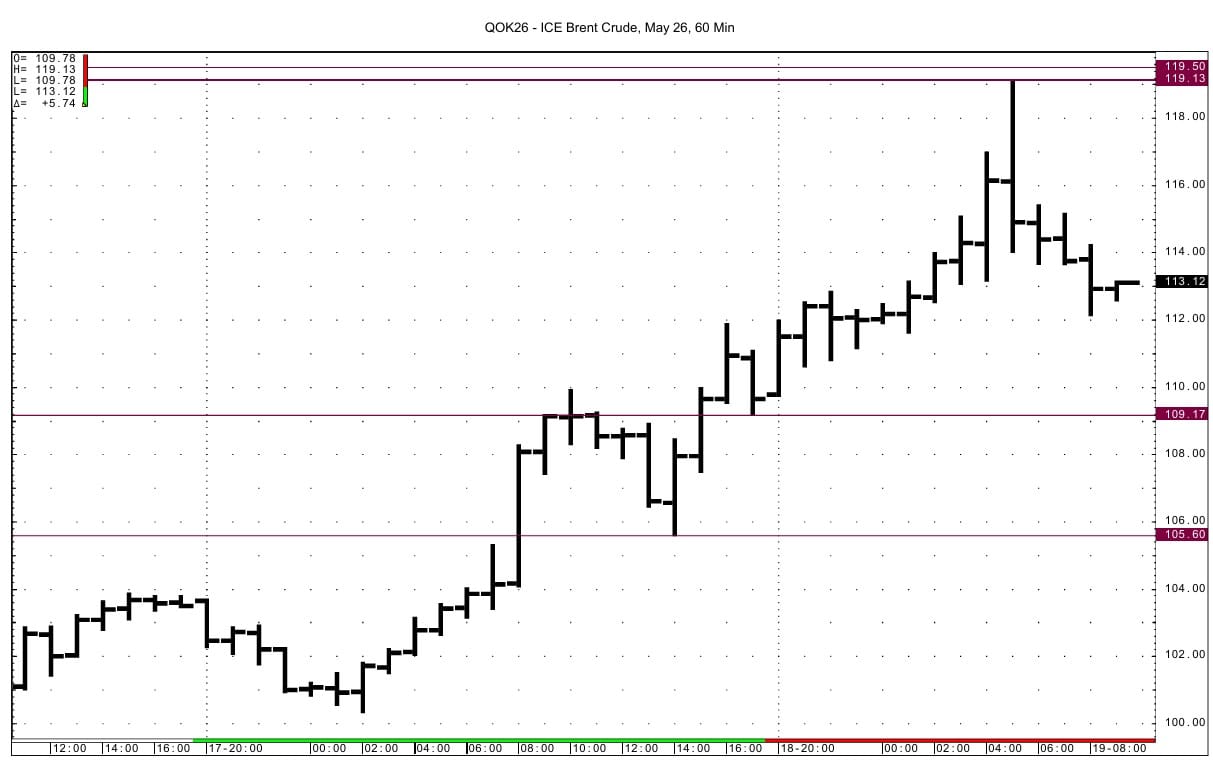
The Brent spot futures have a high today of 119.13, not quite testing the March 9 high of 119.50. Support lies at 109.17-109.27. The overnight low lies above that at 109.78. Next support below comes in at 105.60.
Natural Gas Market Overview
Natural Gas--NG is up 12.6 cents at $3.191
NG futures are higher --following the rest of the energy complex. Again today the NG futures are being led by the December 2026 through February 2027 strip. Concern over an increase in LNG demand next winter outstripping production is said to be behind the winter contracts' strength. European TTF futures have risen to a fresh multi-year high.
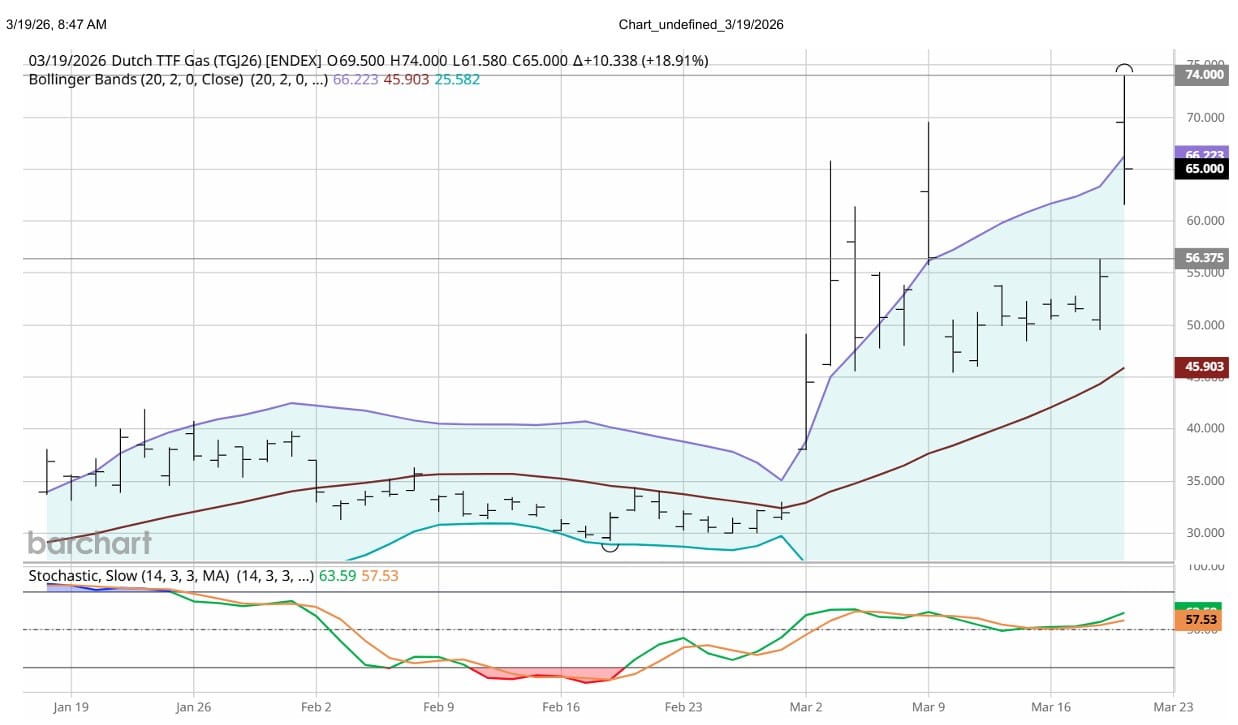
The TTF European gas futures have gapped higher today on the back of the news of the attack on the Ras Laffan LNG plant in Qatar which suffered extensive damage. The damage to the Ras Laffan hub as a result of the Iranian strikes “fundamentally alters the global gas market outlook,” according to Wood Mackenzie. Wood Mackenzie adds that "disruption to global natural gas supply was now likely to last longer than two months, adding such a prolonged outage would keep natural gas prices “elevated for longer.” (CNN) The TTF futures rose to their highest value for the spot contract since January 10,2023. The high today for the spot TTF futures is Euro 74.000, which was an increase of 35.38% from the settlement price from Wednesday. The Euro 74/Mwh price equates to $24.89/MMBtu. The spot TTF futures contract is currently printing near Euro 65/Mwh (=$21.86/MMBtu).
Today's EIA gas storage data is seen as a build of 26 to 31 BCF, as per WSJ and Reuters surveys. That compares to the 5 year average draw of 29 BCF and the 1 BCF draw seen last year.
Late Tuesday saw the 11-14 day cumulative HDD count increase to 100.92 in the Lower 48 states, up from 65.43 in the previous run. This is 48 HDD above the 10-year normal. (Market News)
Regarding the winter contracts' strength, several major US LNG export facilities are expected to be fully operational by 2026/2027, including Plaquemines LNG, Corpus Christi Stage 3, and Golden Pass LNG. While production is expected to rise, demand is forecasted to outpace it, with storage inventories predicted to drop below the five-year average over 2026–2027. (EIA.gov)
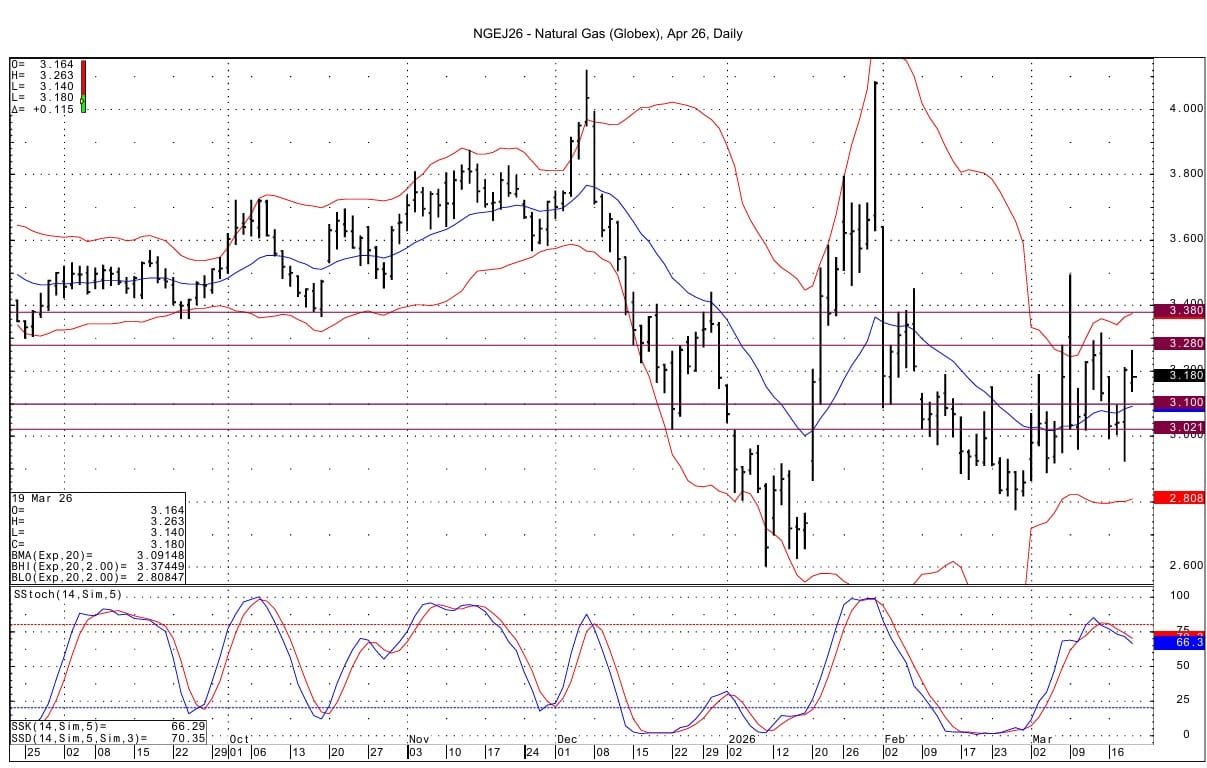
Technically the April NG spot futures still have negative momentum, but they remain mired in the trading range seen this month. Yet, NG futures have again shown that spot futures prices below $3 are not sustainable, given the rebound from sub-$3 seen yesterday. Resistance for the spot April futures comes in at 3.277-3.281 and then at 3.379-3.385. Support is seen at 3.097-3.100 and then at 3.019-3.021.
Enjoyed this article?
Subscribe to never miss an issue. Liquidity’s Daily Energy Market Updates provide a comprehensive analysis of both the fundamentals and technical factors driving energy markets.

Click below to view our other newsletters on our website:

Disclaimer
This article and its contents are provided for informational purposes only and are not intended as an offer or solicitation for the purchase or sale of any commodity, futures contract, option contract, or other transaction. Although any statements of fact have been obtained from and are based on sources that the Firm believes to be reliable, we do not guarantee their accuracy, and any such information may be incomplete or condensed.
Commodity trading involves risks, and you should fully understand those risks prior to trading. Liquidity Energy LLC and its affiliates assume no liability for the use of any information contained herein. Neither the information nor any opinion expressed shall be construed as an offer to buy or sell any futures or options on futures contracts. Information contained herein was obtained from sources believed to be reliable, but is not guaranteed as to its accuracy. Any opinions expressed herein are subject to change without notice, are that of the individual, and not necessarily the opinion of Liquidity Energy LLC
Reply