- Daily Energy Market Update
- Posts
- Daily Energy Market Update April 14,2026
Daily Energy Market Update April 14,2026
Liquidity Energy, LLC
April 14, 2026
WTI is down $2.92 at $92.16 ULSD is down 2.01 cents at $3.8140 June RB is down 4.20 cents at $3.0009
Liquidity’s Daily Market Overview
Energies are lower even as traffic through the Strait of Hormuz remains limited; markets appear to be more optimistic over the chances of a long-term peace agreement between the U.S. and Iran.
The US and Iran are weighing further negotiations to extend a ceasefire even as President Trump presses ahead with a naval blockade to curb the Islamic Republic’s oil exports, a step aimed at extracting concessions in peace talks. Bloomberg adds that the objective is to hold fresh discussions before the truce announced April 7 expires next week. On Monday, Iran warned it would target ports across the Persian Gulf if its own shipping hubs are threatened. (Bloomberg) Saudi Arabia is pushing Washington to halt the blockade, fearing it could prompt Tehran to escalate tensions and disrupt other regional shipping routes, the Wall Street Journal reported. President Trump tweeted that 34 ships had transited the strait on Sunday. Bloomberg reported earlier that 19 vessels passed through the waterway in either direction on Sunday.
Chinese state oil giant Sinopec has bought Russian oil loading in March and April to replace Middle Eastern crude after the U.S. temporarily waived sanctions to ease tight supplies globally. Sinopec is said to have purchased 8 to 10 cargoes of the sweet crude. Each cargo holds 740 MBBL. Sinopec is said to have bought the cargoes at premiums of $8 to $10 per barrel to ICE Brent. Russian crude traded at a discount of about $10 per barrel before the Iran conflict. (Reuters) This news comes on the heels of a report seen last week that said that Chinese independent (teapot) refiners had bought Iranian crude oil at a premium to Brent futures for the first time in years. Two teapots were said to have paid +$1.50/+2.00 for the Iranian Light crude. That compared with a $10 per barrel discount before the Iran conflict began. The cargoes are floating near China and will be delivered this month, the Reuters sources said. The teapots bought the cargoes armed with fresh crude import quotas. Also, refining margins at teapots have improved with lower crude costs and higher domestic fuel prices, encouraging them to look for Iranian oil for prompt delivery, traders said. China's state planner last week urged independent refiners not to reduce processing rates below the average of the past two years, seeking to safeguard domestic fuel supply as state-owned refiners trim output. (Reuters)
Today, the IEA, in its monthly oil report, forecast that “demand destruction will spread” amid growing supply scarcity and higher average prices because of the conflict in the Middle East. The IEA sees global oil demand falling by 80 MBPD this year, compared with a projected year-on-year rise of 640 MBPD in its previous monthly report. The IEA said a projected 1.5 MMBPD drop in demand in the second quarter of this year would mark the deepest contraction since the COVID-19 pandemic. Supply will fall by 1.5 MMBPD this year, the IEA said in its monthly oil market report. The sharp fall now expected contrasts with the agency's prediction of supply growth of 1.1 MMBPD last month and 2.5 MMBPD at the start of the year. Overall, the IEA forecasts imply that supply will be higher than demand by just 410 MBPD in 2026, in contrast to a 2.46 MMBPD surplus projected in last month's report. The IEA says that the effective closure of Hormuz led to a loss of 10.1 MMBPD of supply in March, the agency said, which could deepen by a further 2.9 MMBPD this month, they added. (Reuters/CNBC/Al Jazeera)
China's March crude oil imports fell 2.8% from a year earlier due to a high base, official data showed on Tuesday, while the Iran war curbed refinery runs with Middle East supply disruptions expected to weigh on April imports. March's crude oil imports were seen at a rate of 11.77 MMBPD. Middle East cargoes were loaded in January and February so March imports were not yet affected by Strait of Hormuz disruptions, as per one analyst. But, China is likely to face tighter crude supply in April, with imports expected to be about 2 MMBPD below its average demand from imports, as per Rystad Energy analysis. If refiners are to maintain adequate oil product supply, China will probably need to draw on inventories, even with refinery runs expected to fall by about 1 million bpd in April amid weak margins, as per Rystad's analysis. Chinese refineries' capacity utilization rate was 68.79% in March, down 0.9 percentage points year-on-year, and down 4.47 percentage points from February, according to Chinese consultancy Oilchem. Customs data also showed that exports of refined oil products, including diesel, gasoline, aviation fuel and marine fuel, dropped 12.2% to 4.6 million tons in March. The export ban is seen extending into April. (Reuters)
Retail fuel prices at the pump in the US have stabilized in the past few days. Gasoline at the pump is priced at $4.118 today, as per AAA data. One week ago the price was $4.140. Diesel fuel costs $5.650 today, having gotten as high as $5.689 last week.
Energy Market Technicals
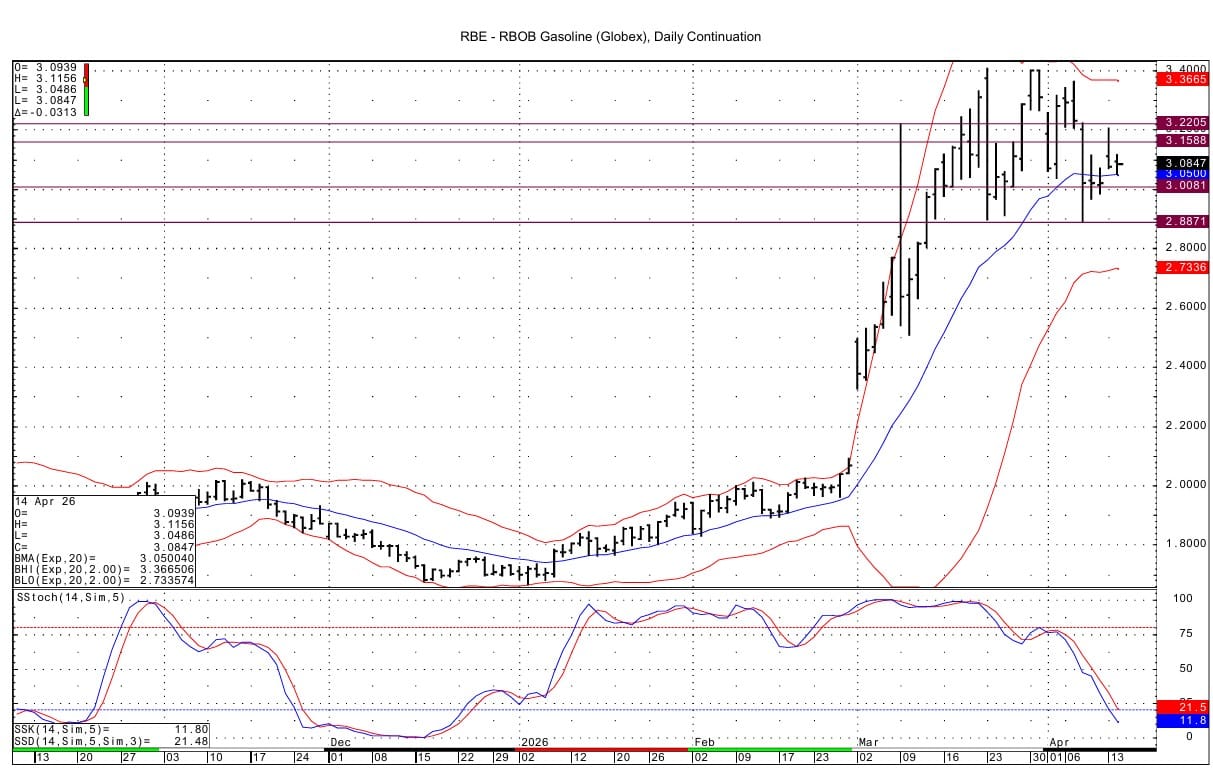
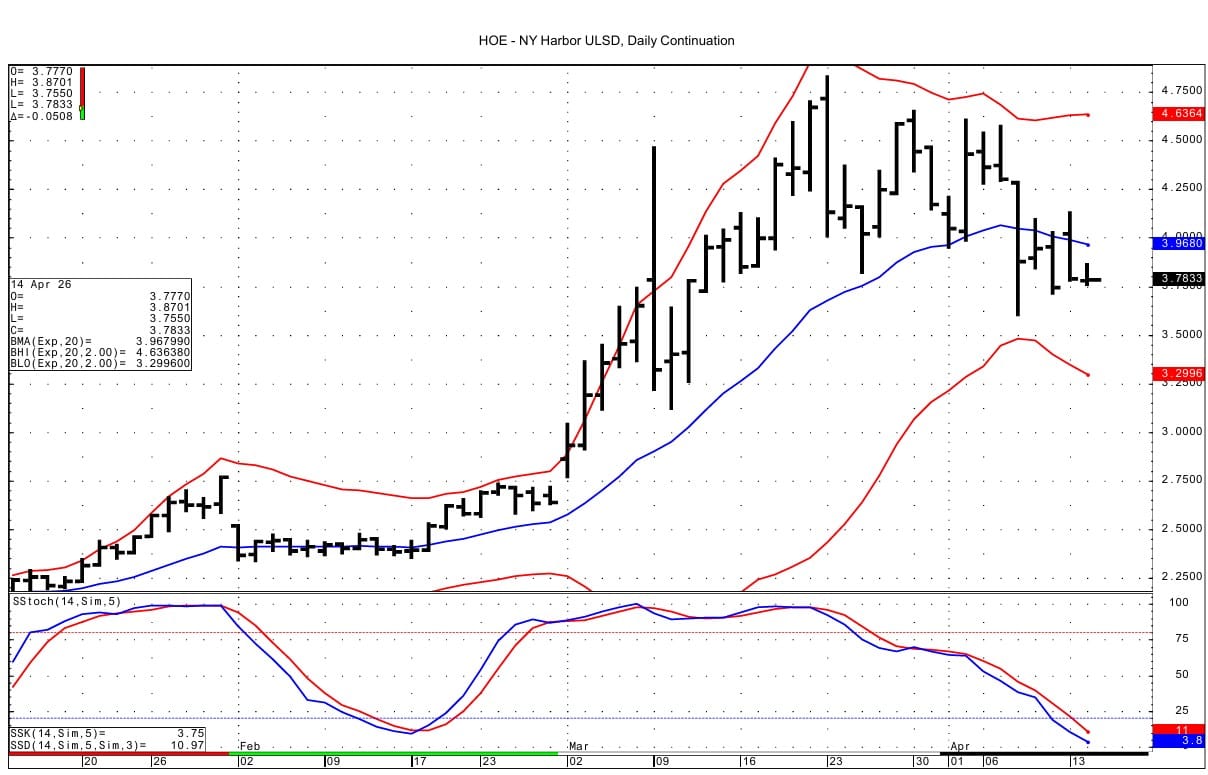
Momentum still points downward for the energies, although in the case of the HO, basis its DC chart, it is getting near oversold.
WTI spot futures see support at 91.96-92.08 and then at 86.34-86.46. Resistance comes in at 101.48-101.67 and then at 105.36-105.63.

June RB support comes in at 2.9058-2.9068. Resistance lies at 3.0855-3.0856.

May ULSD support is seen at 3.7480-3.7500 and then at 3.7100-3.7119. Resistance is seen at 3.8600-3.8608 and then at 3.8971-3.8988.

Natural Gas Market Overview
Natural Gas---NG is up 1.0 cents at $2.637
The drift lower in spot NG futures continued overnight even as some point to the contract being oversold. As one analyst writes: "natural gas sentiment continues to be driven—appropriately so—by an exceptionally bearish near-term temperature outlook." This week's EIA gas storage number is seen as bearish.
Early estimates for this week's EIA gas storage data are calling for a build of 50 to 62 BCF. This compares to last year's build of 22 BCF and the 5 year average build of 38 BCF. Several analysts point to the fact that gas inventories have risen such that the surplus to the 5 year average has risen over +100 BCF, with one analyst expecting the surplus to reach over 150 BCF by the end of the month. As of April 3, the surplus to the 5 year average was +87 BCF. NGI cites a roughly 15% lower than normal HDD count as contributing to the large build. Additionally, NGI adds that Lower 48 natural gas consumption for power generation fell by 4% last week.
Production in the Lower 48 states averaged 111.1 BCF/d so far in April, according to LSEG, near record levels and above March output. While, feedgas flows to the country’s nine major LNG export facilities averaged 18.9 BCF/d in April, near capacity and only modestly above March levels.
The drop in the spot NG futures seen Monday came even as NGI’s Spot Gas National Average price was up 15.0 cents to $1.525/MMBtu, per NGI’s MidDay Price Alert.
Some of the pressure on the front end of the NG curve may be also due to the index fund roll that is ongoing, in which the spot May futures are being sold versus buying of the July futures. This is reflected on the CME open interest data from Monday, in which the May futures open interest fell by over 31,000 contracts, while the July open interest rose by over 27,000 contracts.
Notable options trades seen Monday on the CME include the May/October minus 40 cent call being sold versus buying of the minus 60 cent put for a cost of 5.0 cents. The May/October futures spread settled Monday at minus 59.5 cents. In the July/October CSO, the minus 10 cent call was sold versus buying of the minus 15 cent put at a cost of 1.0 cents. The July/October spread settled Monday at minus 12.3 cents. New positions were established in the July/August CSO. The minus 5 cent call was sold against buying of the minus 10 cent put at a cost of 0.8 and 0.9 cents. The July/August futures spread settled at minus 7.6 cents Monday.
Technically, NG has fallen yet again to a fresh multi month low today. Support at 2.579-2.588 was tested overnight with the low of 2.575. Below that support comes in at 2.514-2.516. Resistance is seen at 2.795-2.796 and then at 2.888-2.897. Momentum basis the DC chart is oversold.


Enjoyed this article?
Subscribe to never miss an issue. Liquidity’s Daily Energy Market Updates provide a comprehensive analysis of both the fundamentals and technical factors driving energy markets.

Click below to view our other newsletters on our website:

Disclaimer
This article and its contents are provided for informational purposes only and are not intended as an offer or solicitation for the purchase or sale of any commodity, futures contract, option contract, or other transaction. Although any statements of fact have been obtained from and are based on sources that the Firm believes to be reliable, we do not guarantee their accuracy, and any such information may be incomplete or condensed.
Commodity trading involves risks, and you should fully understand those risks prior to trading. Liquidity Energy LLC and its affiliates assume no liability for the use of any information contained herein. Neither the information nor any opinion expressed shall be construed as an offer to buy or sell any futures or options on futures contracts. Information contained herein was obtained from sources believed to be reliable, but is not guaranteed as to its accuracy. Any opinions expressed herein are subject to change without notice, are that of the individual, and not necessarily the opinion of Liquidity Energy LLC
Reply